
Back from the Clink: How Ian Glennon went from prisoner to community recovery leader
Speak with anyone who has been on a recovery journey with YMCA Together, and one name is sure to crop up – Ian Glennon.
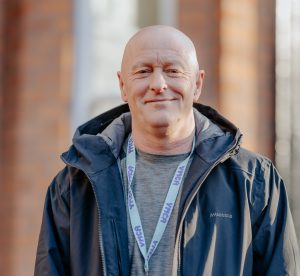
A lynchpin of our RISE Recovery Service since 2019, Ian and his Prehab team are based at Warrant House on 157 Regent Road, where they help people take their first steps to recovery.
Today, Ian is among Liverpool’s most trusted and respected community recovery leaders. But that hasn’t always been the case. From 18 to 42, he was addicted to alcohol, cocaine and heroin. Part of Ian’s experience with addiction was committing crimes and spending years of his adult life in and out of the prison service.
After finally getting clean in 2013, Ian has transformed his experiences into leadership, empathy and frontline recovery work.
This is his story.
___________
The Descent Into Drink and Drugs
Born the youngest of five children to a close-knit family in Norris Green, Ian’s childhood was typical of the late 70s and early 80s – spending his free time with friends on a former railway path (known locally as ‘The Raller’), building dens, camping, and playing football.
It was here that, aged 11 or 12, Ian had his first encounter with alcohol. After breaking into a garden shed that backed onto the railway line, he and his friends found a bottle of homebrew.
“It was horrible,” he said.
Although it didn’t feel like it at the time, it was a sign of things to come.
By the early 1980s, heroin had Liverpool in its grip. But despite his friends using, Ian never touched the drug until he was 19. After buying heroin for a friend who was ‘rattling’ from withdrawal, curiosity finally got the better of him. As Ian puts it:
“If you sit in the barber’s all week, you’ll eventually get your hair cut,”
The two of them went to a nearby flat, where Ian tried heroin for the first time.
Its impact was instant. Ian’s descent was rapid.
____________
Reaching Crisis Point
Crack cocaine followed. Drugs and alcohol had Ian in their grip. Soon, he committing crime to get his hands on cash for his next fix – burglaries, shoplifting, fraud.
Not only had addiction led Ian to harm and despair, his increased criminality also saw him spend much of the next two decades behind bars. In 2013, the Home Office imposed an undetermined, indefinite prison sentence on him. His methadone use spiralled.
After 22 years addicted to alcohol, cocaine, and heroin, Ian had hit crisis point. Until later that year:
“I came out of the cells one day and thought, ‘I can’t do this,’” said Ian, “For the first time in life, I asked for help. I came off methadone in prison. I got clean.”
Upon his release, Ian headed to the Park View Project – Liverpool’s primary abstinence-based recovery programme before RISE. His rehabilitation had finally started.
____________
From Recovery To Role Model
Ian was treated at the Park View Project for 6 months, tackling his addiction and prison-learned behaviours head-on.
“It saved my life,” said Ian.
After completing his treatment, Ian volunteered at the Park View Project for 18 months before securing a role as night support at the centre, where he looked after 30 residents.
Soon, he became a key worker. In 2019, he joined YMCA Together’s newly formed RISE Pathway as a link worker. But it was as a detox community practitioner where Ian found his calling. Here, he could go into the local area to support people facing the challenges he once faced.
Ian and his team – Maureen, Mark, and Terry – now use their combined experience to help those taking the first steps toward recovery.
___________
Supporting The Community
Given his experience with methadone detox, treatment processes, and the criminal justice system, being a community practitioner is the perfect fit for Ian.
The prehab group he leads at Warrant House is a common first step into RISE. The sessions, held every Friday at 10.30 am, eases people into group work and supports those still in active addiction.
Ian and his team run the group with compassion and clear boundaries. Many people attending Prehab are in active addiction, so the team has to judge whether someone is well enough to participate.
“The biggest obstacle is when people are under the influence too much…you’ve got to be mindful,” Ian explains.
If someone is so intoxicated that they’re unable to join the session safely, the team makes sure they are supported and knows they’re welcome back when they’re in a better place.
“The last thing you need is to be talking to the bottle,” says Ian, “However, we have a policy here if an active alcoholic comes in and they’re shaking, believe it or not, we’d rather say, “Go and get a can of lager to settle your nerves, because we can’t have you sitting in our group, withdrawing.”
Beyond the prehab service, Ian spends the rest of his week on outreach at Altcourse Prison, Walton Prison, Royal Liverpool Hospital, Aintree Hospital, and other community services.
“We work hand in hand with a lot of the recovery services, primarily River Liverpool Drug and Alcohol Support Services,” says Ian, “We’re the first port of call for those who need support with recovery.”
_____________
Setting People On The RISE Pathway
The Prehab group is accessible to anyone who needs support. People can refer a friend or loved one. Referrals also come from the prison and probation services, hospitals, hostels, River, GPs and other local services.
Whichever way people make their way to Prehab, the process is the same.
First, service users must attend five or six Prehab sessions to demonstrate willingness.
Next, the YMCA team, including a team leader and a CAT Specialist, carry out a complete clinical assessment, considering risk factors, safeguarding, medication, and suitability for RISE. The vast majority of applicants are accepted and added to the RISE waiting list.
Families hope for an instant solution, and Ian understands how hard waiting can be. However, service users must be entirely abstinent before accessing RISE. Those in active addiction require a detox in the Hope Centre, organised through River or the doctors.
“It’s heartbreaking. Concerned families expect you to have a magic wand and a solution overnight. We haven’t. It’s a process,” says Ian.
YMCA Together will match detox dates with the available bed spaces in RISE, supporting people through 10-day alcohol detox or four-week methadone detox.
Once detox is complete, Ian and his team pick up the service user and take them straight into residential treatment at RISE.
______________
What Ian Wants You to Know About Recovery

There is a significant, often overlooked, recovery community in Liverpool. Even if someone isn’t ready or suitable for an 18-week residential programme, there are other pathways available through our friends at CGL, SHARP, Bridge Housing, the NHS, Merseycare, and more.
“We’ll pathway you to wherever you want to go. Hopefully it’s into RISE, but if not, we’ve no problem sending people to places where they can find support” said Ian, “Don’t suffer in silence. Drop in, talk, ask for help. We’re here for you.”
From 22 years in addiction and decades inside prison to becoming a respected community practitioner, Ian’s journey is now woven into the recovery journeys of hundreds of others.
His lived experience helps remove fear and stigma for those needing support. People look at him, Maureen, Mark, and Terry as proof that recovery is possible. Their positive influence is felt across the community.
“That’s the big difference. People think, ‘You’ve done it, and I know how bad you were. I can do it, too.'” says Ian. “The biggest prison was my mind.”
__________
Need support?
Call our rehab service on 0151 474 0685 and find information about your local service here.
If you’re a friend or family member impacted by a loved one’s drug or alcohol issues, you can find help and support here.