
Mark’s Journey Through Recovery and Beyond
Mark’s Journey Through Recovery and Beyond
A lot has changed since Mark’s first visit to Prehab. When he walks into the recovery service now, it’s as a volunteer. He helps with referrals, arranges appointments, and supports people as they start their recovery journey. It’s a far cry from his first visit, when he sat in a group unable to speak, quietly shaking his head when asked if he’d like to share his story.
Being allowed to say nothing in that moment meant more to Mark than he realised at the time. It was the first step that took him from crisis to stability, and eventually back to Prehab – not as a service user, but as someone giving back to the community.
This is his story.
From social drinking to dependency
Like many people, Mark’s drinking started with socialising at the pub. But by his late twenties, job pressures changed his relationship with alcohol. Work eventually took him to the Isle of Man and away from his support network. As stress grew, alcohol became a coping mechanism. A few glasses turned into four bottles of wine, then five, then six. Evening drinks became morning binges.
“It got to the point where, before I was going into work, I was having a bottle of wine,” he said. “I was drinking it on the street – behind Sainsbury’s, just necking a bottle of wine.”
By the time Mark returned to Liverpool after a relationship breakdown, alcohol had taken control. He drank before work, at lunch, and straight after shifts when he’d down another bottle before catching the train. Then there was more wine at home, and the cycle started again. Despite the tell-tale signs of his drinking, it went largely unchallenged at work, with colleagues either laughing it off or Mark explaining away the smell of alcohol on his breath. His addiction was hiding in plain sight.
Reaching crisis point
The consequences of Mark’s drinking were severe. He developed epilepsy. A drunken fall broke his shoulder. But even hospitalisation didn’t stop him from drinking. At his lowest point, believing there was no other way to escape addiction, he took an overdose. His Dad found him and called an ambulance. Mark spent days in an induced coma and weeks in hospital.
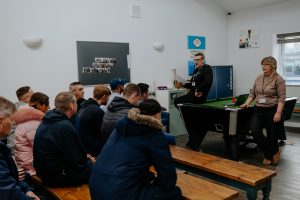
After leaving the hospital, Mark went to Prehab because other services didn’t feel right for him. Meeting Ian Glennon was a turning point. There was no pressure to talk or to being recovery right away. Instead, he found an open door, and a welcoming atmosphere of professionals and peers.
“I went to my first meeting, and I couldn’t even speak. Ian said, ‘If you don’t want to speak, we’ll just pass you.’ So I just shook my head. But after that, I started speaking a lot more.”
Opening up in the weekly groups was the start of Mark’s journey on the RISE pathway. His GP referred him to the Hope Centre for detox, where he received medication to manage alcohol withdrawal. The physical effects of stopping drinking were intense, but detox provided a protective environment. It was the first time in years that Mark could focus on getting well.
The Pathway to Recovery
Crucially, the system worked as a joined-up process. In the past, delays between detox and residential support led many people back to the bottle. Mark was able to go from detox into RISE without delay. There, he found structure, routine, and a supportive community of people who understood addiction, including staff members with lived experience. He realised he wasn’t alone.
After finishing RISE, Mark moved into Step Down accommodation, which gave him more independence. Then he moved to supported living at Hill Street, where staff encourage residents to rebuild their lives with stability and responsibility. For the first time in decades, Mark could imagine a future that didn’t revolve around alcohol.
“The RISE staff can relate to what you’re going through. I really enjoyed my time there.”
Moving forward and giving back
Today, Mark volunteers with YMCA Together. He supports staff, helps with workshops, and plays a key role in organising wellbeing activities for people in RISE, including cultural events and community visits. The focus is on helping people get out, reconnect, and remember that there’s life beyond addiction.
Mark also works with Ian on referrals, visiting hospitals and prisons to support people in crisis. Seeing addiction in the prison system reminds him how easily progress can be undone without proper aftercare, and how important support is before and after treatment.
In addition to his work with YMCA Together, Mark volunteers with Sahir House and leads Pride and Recovery sessions at Prehab. He was recently recognised for his impact in the community.
Organisations like Prehab, he says, save lives. They offer safety, stability, and a way forward when people feel like they’re out of options.
“The best thing that I did was coming to this group,” he said. “Once you go through that process – detox, RISE, Step Down – and you see someone go from being on their knees to being healthy, it’s an amazing transformation.”
_____________________________________________________________________________________
Need support?
Call our rehab service on 0151 474 0685 and find information about your local service here.
If you’re a friend or family member impacted by a loved one’s drug or alcohol issues, you can find help and support here.
________
Here for you, wherever you’re at.